


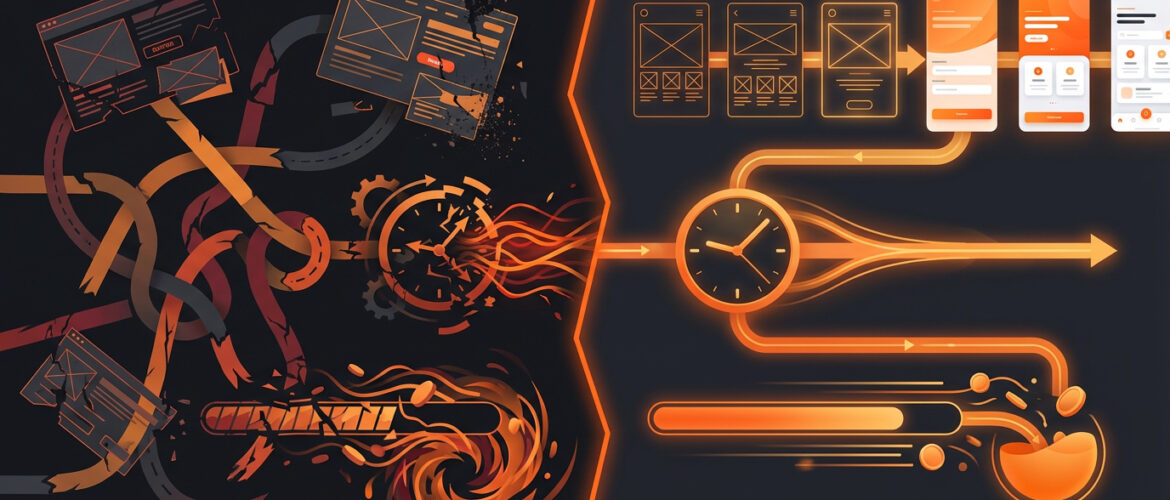
In a digital product development process, the most expensive thing is not the software itself.
The most expensive thing is realizing too late that the idea was misunderstood.
This is exactly where prototypes and mockups come into play. These steps are often skipped with the mindset of “we’ll build it anyway, let’s start developing right away.” In reality, however, they significantly reduce both the timeline and the overall cost of a project.
In this article, we explain what prototypes and mockups are, the difference between them, and why they save both time and money, in a clear and simple way.
What Is a Mockup?
A mockup is a static visual representation of how a digital product will look.
Buttons, colors, typography, layout, and the overall visual language are defined in a mockup. However, mockups do not function; they are not clickable and do not produce real data.
In the simplest terms:
A mockup answers the question, “What will this product look like when it’s finished?”
What Is a Prototype?
A prototype takes things one step further than a mockup.
It shows not only how the product looks, but also how it works.
Buttons can be clicked, pages can transition, and user flows can be tested. It is not real software, but it offers the closest possible experience to the final product.
In short:
Mockups are visual, prototypes are experiential.
Why Spend Time on These Steps?
At first glance, mockups and prototypes may seem like extra work.
The question “Why not just build it directly?” comes up often.
In reality, these steps are not about doing the work twice; they are about avoiding building the wrong thing.
They Eliminate Misunderstandings Early
One of the most common problems in projects is this:
Everyone uses the same words, but imagines different things.
Terms like “user dashboard,” “simple screen,” or “fast flow” mean different things to different people. Mockups and prototypes remove this ambiguity.
Everyone sees the same screens and experiences the same flow.
Feedback becomes concrete instead of abstract.
Making Changes During Development Is Very Expensive
Changing something on paper takes minutes.
Changing it in a mockup takes hours.
Changing it in live software can take days or even weeks.
When an issue is discovered at the prototype stage:
- No code needs to be rewritten
- No test environment is affected
- There is no costly rollback
This directly translates into saving time and money.
User Experience Is Tested in Advance
A product that works is not necessarily a product that feels good to use.
Prototypes allow teams to answer critical questions early:
- Does the user understand this step?
- Is this button in the right place?
- Is the flow unnecessarily long?
A near-real user experience is tested before development even begins, significantly reducing expensive UX revisions later.
Decision-Making Becomes Faster
Verbal explanations and written documents slow down decision-making.
Everyone pictures something slightly different.
Mockups and prototypes create a single, shared reference point.
Instead of asking, “Is this what we mean?”
The conversation shifts to, “Should we do it this way?”
This reduces the number of meetings, revision cycles, and uncertainties.
Development Time Is Shortened
For developers, the most inefficient scenario is constantly changing requirements.
With prototypes and mockups:
- The scope is clear
- The number of screens is defined
- User flows are already thought through
This clarity shortens development time significantly. Developers build what has been defined, rather than guessing what is needed.
Budgets Stay Under Control
The main reason project budgets exceed expectations is late-stage changes or additional features.
Prototypes and mockups:
- Clarify the scope early
- Surface “nice-to-have” requests sooner
- Reduce surprises during development
As a result, the budget becomes far more predictable throughout the project.
They Improve Communication With Stakeholders and Investors
Explaining an idea is hard. Showing it is easy.
A prototype helps stakeholders and investors quickly understand:
- The logic of the product
- Its potential
- The experience it offers to users
This speeds up approval processes and builds confidence.
Are Prototypes and Mockups Necessary for Every Project?
They may not be required for very small, single-screen tasks. However, for:
- Large-scale projects
- Mobile applications
- New product development
- Experience-driven products
prototypes and mockups are nearly indispensable.
In Summary
Prototypes and mockups:
- Resolve misunderstandings early
- Reduce the cost of change
- Shorten development timelines
- Keep budgets under control
- Lead to better user experiences
In short, they are not an extra cost—they are investments that save time and money.